Lecture 1 (1/5)
- Key questions: distributions, sampling, features of a system
- Random Sampling
- Ising Model
- The main idea is that sampling allows integration, scales better than grids, and solves impossible sums.
Lecture 2 (1/7)
Example 1:
Let be a particle with the following ODE
Let . Then
such that
Upon solving this ODE, we get
So, as .
Example 2:
We could have a double well
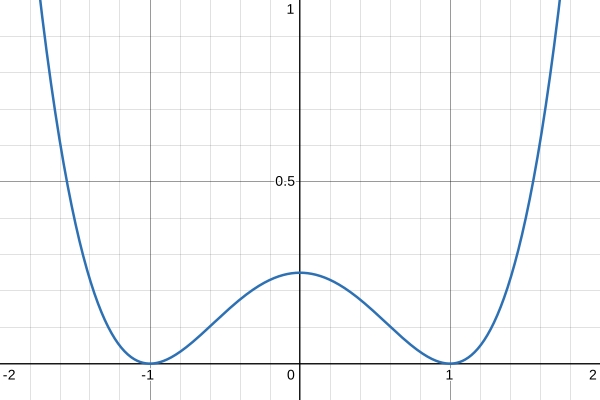
In the SDE case, given
In order, the terms are:
- is the change
- is the deterministic force
- is some “random” force. In particular, is the Brownian increment, or “white noise”.
So when we calculate the position of the particle via , the term tells us how we move via the force, with some randomness via . This leads to
- new frequency in a system
what does frequency mean?
- new types of resonance/transport effects.
Lecture 3 (1/9)
Reference for this section is Rubinstein Ch.2
Lecture 4 (1/12)
Reference: Rubinstein Ch. 2, 2.4, 2.3.4
Lecture 5 (1/14)
- Acceptance-Rejection
- [[Acceptance-Rejection#theorem-uniformity-on-region-a|Theorem (Uniformity on Region )]]
- [[Acceptance-Rejection#theorem-from-uniformity-on-a-to-target-fx|Theorem (From Uniformity on to Target )]]
- [[Acceptance-Rejection#theorem-a-r-generates-z-sim-f|Theorem (A-R Generates )]]
Lecture 6 (1/16)
Lecture 7 (1/21)
Lecture 8 (1/23)
Lecture 9 (1/26)
- Review of previous lectures.
- Markov Chains. For the purposes of this class we only consider Discrete Time/State Homogeneous Markov Chains
- Stochastic Process
Lecture 10 (1/28)
Lecture 11 (1/31)
Lecture 12 (2/2)
Lecture 13 (2/4)
Lecture 14 (2/6)
Lecture 15 (2/9)
- Review for midterm
Lecture 16 (2/13)
- Review on Metropolis Algorithm
- Gibbs Sampler
Lecture 17 (2/19)
- Remarks. important!
Lecture 18 (2/20)
Lecture 19 (2/23)
Lecture 20 (2/25)
Lecture 21 (2/27)
Lecture 22 (3/2)
Lecture 23 (3/4)
Lecture 24 (3/6)
- Example 3 (Apply OU on Ito SDE)
- Example 4 (Geometric BM)
- Example 5 (Geometric BM with Log Expectation)
- Example 6 (Arithmetic BM with Drift)
- Applying Units
- 2D SDEs
Lecture 25 (3/9)
Lecture 26 (3/11)
Lecture 27 (3/13)
- Finals review