Assume PDF is our target PDF and that
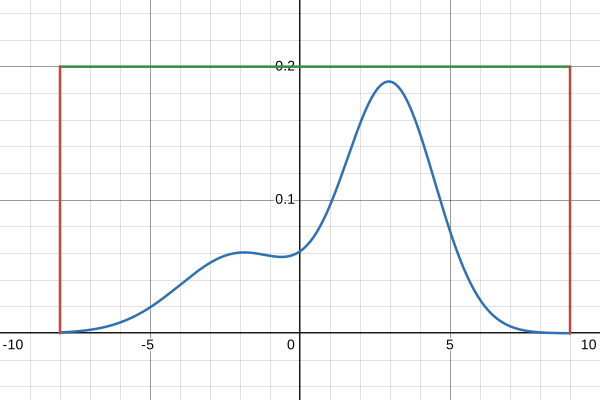
Naive Algorithm
- Generate . For example, let and .
- Generate independent of .
- If , accept and set .2
Why does this work?
- is uniformly distributed in the box . This means that the accepted pair is uniformly distributed on
- The area of is , since the area of is .
- This implies that the marginal PDF for accepted is then
- This tells us the distribution of accepted is .
- This integral works because we are integrating over , and the PDF is only defined between and . The joint PDF collapses to , because it is the value of the accepted points during sampling.
General Algorithm
We can write a more general A-R method. The goal now is to sample from a target PDF
For intuition sake, we can imagine .
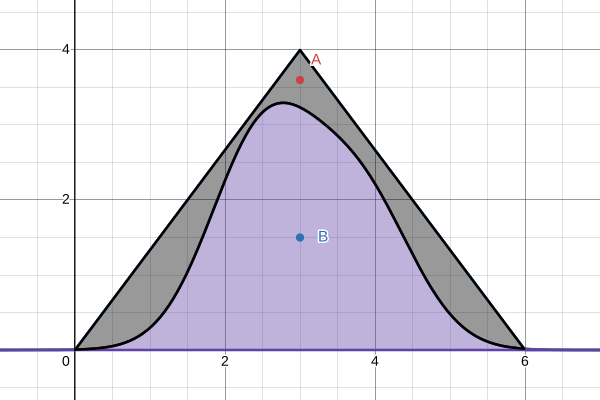
The top part is and the purple part is .
We want to find a PDF and such that
- We know how to sample from . is called the proposed PDF. It is close to and easy to sample from.
- for all . is called a majorizing function of .
- Note that is required because is a PDF which integrates to .
- We want to be as small as possible.
Acceptance-Rejection Algorithm
Given target PDF , find proposal PDF and constant such that for all .
- Generate where .
- Generate where .
- If , then accept and set . Otherwise, we reject and go step 1.
We want to measure the following rates:
Efficiency
The probability of acceptance is: Where and correspond to the volumes under the curves:
Thus, the expected acceptance rate is .
Theorem (Uniformity on Region )
Let the relevant geometric regions be defined as:
The pair obtained from Steps 1 & 2 is uniformly distributed on .
Proof:
- Let be the joint PDF of .
- Let be the conditional PDF of given .
Recall from theorem that the joint PDF is equal to the conditional times marginal. Since (Step 1), we have:
From Step 2, we generate . The PDF of a uniform distribution on is , so:
Substituting this back into the joint PDF:
Since the PDF is constant on the support , is uniformly distributed on .
Theorem (From Uniformity on to Target )
We established that the candidate points are uniform on .
How does ?
Proof:
Let be the first accepted point. Because and we strictly accept points within , the accepted points are uniformly distributed on :
is the area under the PDF , so its total volume is . The joint PDF of the accepted point is therefore:
To find the distribution of just the -values, we take the marginal of :
Thus the accepted samples follow the target distribution .
Theorem (A-R Generates )
This theorem explains why this works via geometric intuition.
Consider the graph of enveloping .
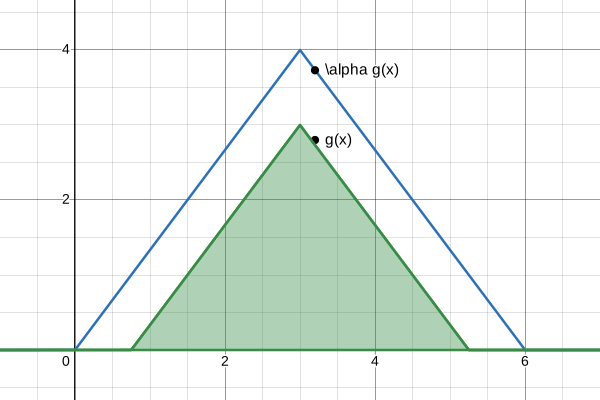
- Step 1 (): is more likely to fall where is big. This leads to a “mushing” (clustering) of points along the x-axis at the peaks.
- Step 2 (): Choosing gives “more space” for to be uniform where is large.
This vertical expansion compensates for the horizontal “mushing” of . The high horizontal density (large ) low vertical density (large range ) gives us a near 2D constant density in . These effects cancel out perfectly, see from Theorem (Uniformity on Region A). This allows us to cut out the shape of or region . The remaining points (accepted points) form .
In general, this is easy to visualize in , but this method provides justification for .
Modified A-R
Let be our target PDF and be our proposal PDF. Let where for all .
- Generate
- Generate .
- If then accept . Set . Else, reject and go to Step 1.
Example 1 (Sampling Standard Normal via A-R)
Let suppose we wanted to sample , the standard normal. So,
and let
Visually,
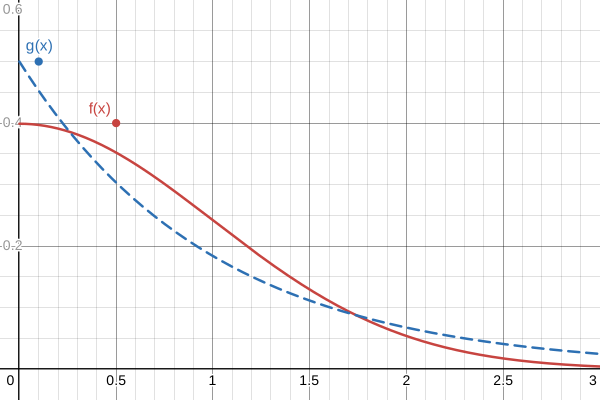
Note that is the exponential distribution which has PDF for multiplied randomly .
To do Step 1 (generate ) we need to:
- Generate independently. Let be transformed by Inversion and be .
- Set
- Now we find such that for all .
For our case, we can set
This allows us to sample computationally.